
Knotchat — دردشة مجانية مع الغرباء أونلاين | فيديو ونص مجهول
تحدّث مع أشخاص من جميع أنحاء العالم
اعثر على أصدقاء جدد في جميع أنحاء العالم من خلال الدردشة المجهولة. تواصل فورًا، وشارك القصص، واكتشف محادثات رائعة — دون تسجيل.
اعثر على أشخاص يفهمونك
اكتشف صداقات تبدأ بـ مرحبا بسيطة. شارك اهتماماتك، وأجرِ محادثات حقيقية، وأنشئ صلات تشعر بأنها حقيقية.
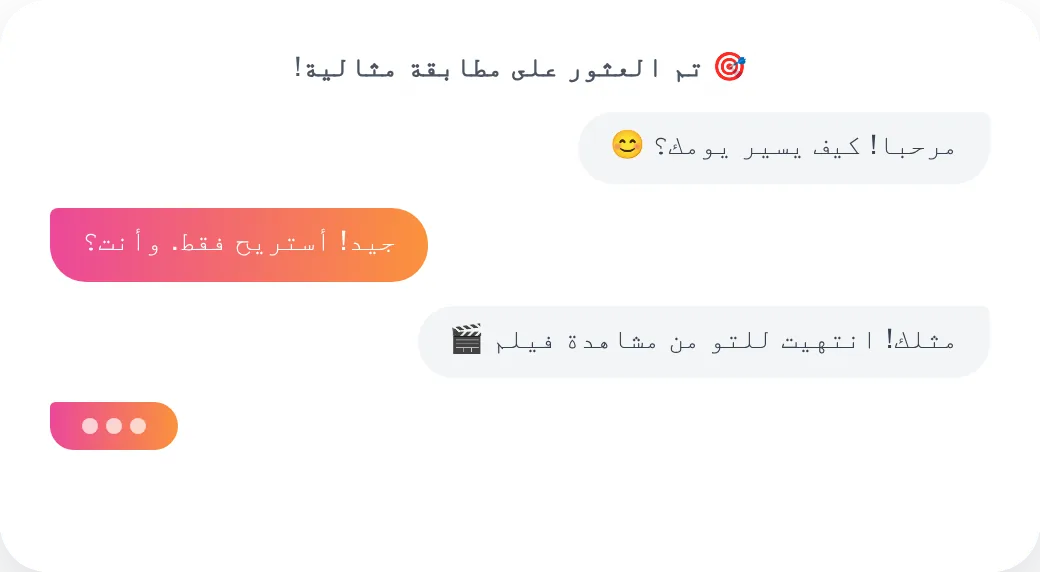
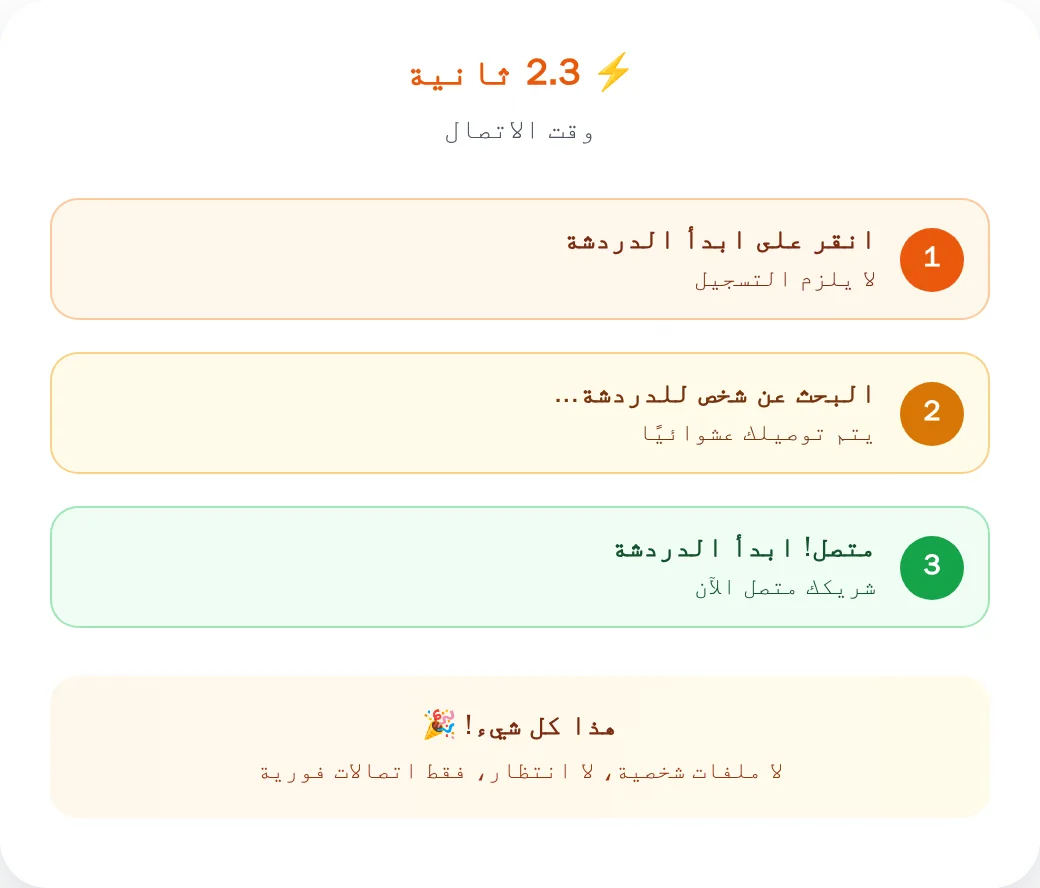
ابدأ الدردشة في ثوانٍ
لا ملفات شخصية لملئها، لا انتظار! فقط انقر وستكون في دردشة مع شخص جديد. الأمر بهذه البساطة.
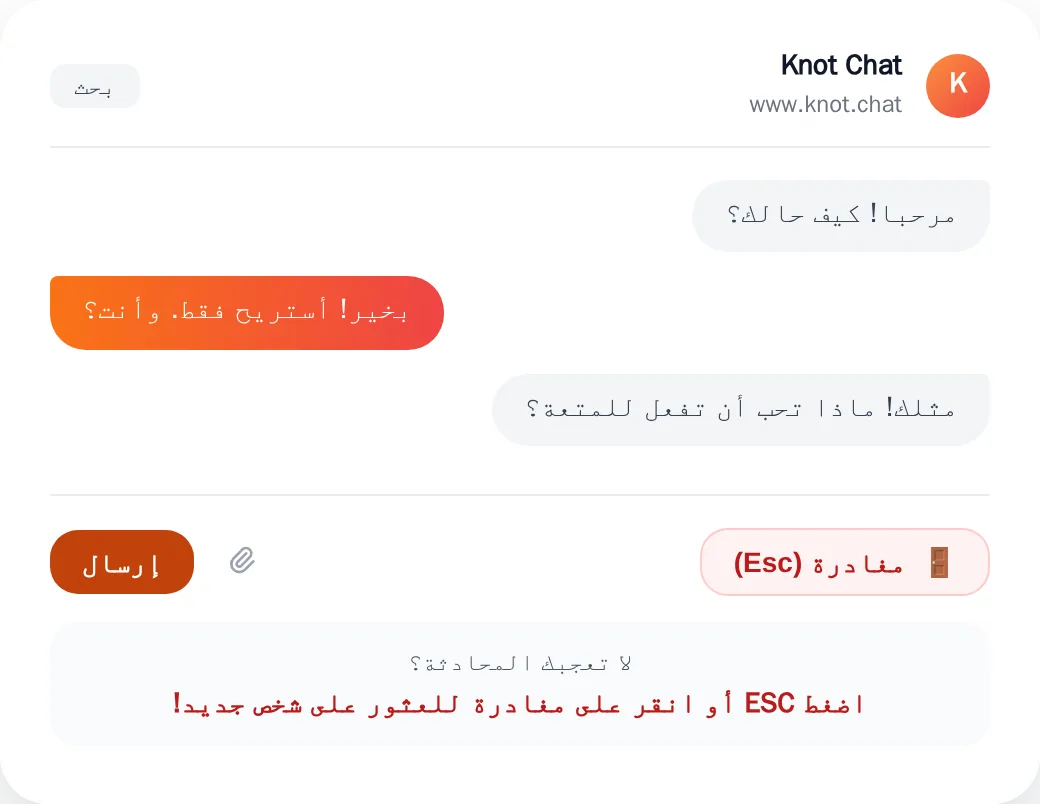
غادر في أي وقت بنقرة واحدة
لا تشعر بالراحة؟ لا مشكلة! فقط اضغط على مغادرة وستجد فورًا شخصًا جديدًا للدردشة معه. راحتك هي الأولوية.
الطريقة السهلة للدردشة مع الغرباء عبر الإنترنت
منصة دردشة نظيفة وحديثة تركز على المحادثات الحقيقية. مطابقة سريعة، ومرشحات ذكية، وتصميم خفيف للتواصل الطبيعي.
تصميم يرتكز على النص
دردشة عبر الإنترنت بسيطة وسريعة كتجربة أساسية — تحدّث مع الغرباء دون تسجيل أو كاميرا.
جلسات مؤقتة
دردشة مجهولة عبر الإنترنت بدون قائمة أصدقاء أو سجل. الجلسات مؤقتة بحسب التصميم.
مرشحات ذكية
استخدم الاهتمامات أو المواقع لتحسين الدردشة العشوائية مع الغرباء والعثور على الأشخاص المناسبين بشكل أسرع.
البشر فقط
محادثات بشرية فقط — مكان أكثر أمانًا للمحادثات الحقيقية مع أشخاص حقيقيين.
آمن ومحمي
حمايات متقدمة ومرشحات أذكى تساعد في إبقاء المحادثات نظيفة ومحترمة.
سريع كالبرق
حجم أدنى، تحميل سريع، وتفاعلات سلسة حتى على الأجهزة منخفضة الإمكانيات — مثالي للدردشة العشوائية عبر الإنترنت.
البديل الأول لـ Omegle منذ عام 2024
أغلق Omegle في عام 2023. انتقل الملايين من المستخدمين إلى Knotchat — دردشة عشوائية مجانية مع أشخاص حقيقيين، ومطابقة فورية، وميزات أمان لم يمتلكها Omegle قط. بدون بوتات. ابدأ الدردشة في ثوانٍ.
تعرّف لماذا نحن أفضل بديل لـ Omegleمحبوب من الآلاف من المستخدمين حول العالم
قصص حقيقية من أشخاص وجدوا تواصلًا ذا معنى عبر Knotchat — البديل الموثوق لـ Omegle للدردشة المجهولة الآمنة.
سجّلت في أقل من دقيقة وتطابقت بسرعة. الدردشة النصية العشوائية تبدو أكثر أمانًا من مواقع دردشة Omegle القديمة.
أستخدم المرشحات للتحدث مع غرباء يشاركونني هواياتي. رائع لممارسة الإنجليزية وتكوين أصدقاء عبر الإنترنت.
واجهة نظيفة، وإعداد سريع، وبدون رسائل مزعجة. تمامًا ما أردته من بديل Omegle للدردشة المجهولة.
مراجعات موثّقة
جميع المراجعات من مستخدمين حقيقيين وموثّقين
99.2% وقت تشغيل
خدمة موثوقة يمكنك الاعتماد عليها
آمن ومحمي
خصوصيتك وأمانك هما أولويتنا القصوى
Why people use Knotchat to chat with strangers
Knotchat is built for people who want to chat with strangers online without a long signup flow or a public social profile. The main page still keeps the chat experience first, then gives enough detail for users and search engines to understand what the product does. A visitor can come for a random chat, start with text, move toward video when it feels right, and leave a conversation without pressure. That simple path matters because most people searching for talk to strangers, anonymous chat, or an Omegle alternative are not looking for a long article. They want to know whether they can start quickly, whether the conversation is temporary, and whether they have basic control if the match is not right.

Fast entry without a profile wall
The homepage keeps the chat action close to the top. People can understand the purpose of Knotchat quickly, choose how they want to begin, and avoid a long profile setup before they know whether the service fits them.
Anonymous conversations by default
Knotchat is positioned around temporary one to one conversations rather than public timelines, follower counts, or permanent identity pages. That helps match the search intent behind anonymous chat and random stranger chat.
User control during every chat
A stranger chat product has to make control obvious. Users should know they can leave, report, block where available, and try another match instead of staying in a conversation that feels uncomfortable or irrelevant.
How Knotchat works
Knotchat should be easy to understand before a user starts a conversation. The flow is simple: open the homepage, choose a way to chat, get matched with a stranger, then decide whether to continue or leave. This explains the product without changing the first screen or turning the homepage into a guide. It also helps search engines connect the page with real user questions such as whether registration is required, whether text chat is available, whether video chat exists, and what happens after a match begins. The important point is that the homepage describes the same actions the user can actually take in the product.
Choose how to begin
Start from the main chat entry and use the mode that feels most comfortable. Text is useful for a low pressure first message, while video can be used when a user wants a more direct live conversation.
Connect into a one to one chat
Knotchat is designed around direct stranger chat rather than a directory of profiles. The user does not need to browse a social feed before having a real conversation.
Continue, report, or leave
If the conversation is useful, the user can keep talking. If it is not a good fit, the user can disconnect and look for another match. If behavior crosses a line, reporting gives the product a signal to review.
Ways to chat
People describe the same product need in different ways: text chat with strangers, random video chat, anonymous chat, talk to strangers online, or a modern Omegle alternative. Knotchat should cover those phrases naturally because each phrase represents a slightly different user concern. Some users want to type first and keep the interaction quiet. Some want a live video conversation because it feels more immediate. Some care most about not creating a permanent public identity before talking. The homepage should explain those modes clearly, but it should not overemphasize sensitive filters or make the page look like a keyword wall. The best content is practical, short enough to scan, and tied directly to real product paths. This section also gives Google clearer topical coverage without changing the top conversion flow: text chat covers cautious first contact, video chat covers real time presence, and anonymous chat covers privacy-sensitive discovery.
Text chat with strangers
Text chat is the easiest starting point when a user wants a low pressure conversation. It works well for quick questions, casual introductions, language practice, shared interests, or moments when turning on a camera is not comfortable. Text also gives people more time to decide whether the match feels respectful.
Random video chat
Random video chat is useful when a user wants a more direct sense of the person on the other side. Video can make a conversation feel more real, but the homepage should frame it with control: users should be able to start carefully, leave when needed, and avoid sharing private details.
Anonymous chat online
Anonymous chat means the interaction can stay temporary. Users do not need to build a public profile just to talk with someone new. The page should also explain the boundary: anonymous does not mean rule free, and safety controls still matter in every chat.

Safety and trust
Safety content is not optional for a stranger chat homepage. Searchers comparing Knotchat with sites like StrangerLine, OpenTalk, TalkWithStranger, OmeTV, and Chatroulette want to know whether the product gives them basic control. The right message is honest and specific: no public stranger chat can be risk free, but users should see clear ways to leave, report, reduce personal exposure, and understand moderation boundaries. That is stronger than vague claims such as completely safe or totally verified. It also improves E-E-A-T because the page explains what is real, what is user controlled, and what the product team can review through feedback signals. This is also where Knotchat can separate itself from thinner competitor homepages: instead of only saying start chatting, it explains how a user can manage risk before, during, and after a conversation.

Leave a chat when it does not feel right
Disconnecting should be treated as a normal product action. Users should not feel locked into a conversation that is boring, uncomfortable, spammy, or disrespectful. This directly supports safer random chat behavior.
Report harmful or suspicious behavior
Reports give the product a way to identify abuse patterns, spam, harassment, and policy violations. The homepage should describe reporting as a real safety signal without claiming that moderation catches every problem instantly.
Block or avoid repeat unwanted contact where available
If the current product exposes block or avoid controls, the homepage should name them plainly. If a control is still being improved, the copy should stay general and focus on the user ability to end a bad interaction.
Protect privacy during anonymous chat
Users should be reminded not to share private information too early. Anonymous chat lowers the pressure to expose identity, but the safest experience still depends on careful user behavior and clear product boundaries.
Use feedback to improve moderation
Post-chat feedback can help separate respectful conversations from low quality matches. This is also the right source for future public trust evidence, but only after the data is real and reviewed.
Knotchat compared with other stranger chat sites
Competitors often rank because they answer comparison intent directly. Knotchat should do the same without attacking competitors or making unsupported claims. This table helps users compare common stranger chat options by feature type and use case. Competitor notes should stay limited to what public pages generally present, while Knotchat copy should only describe real product behavior. The goal is not to create a link wall or a long versus article on the homepage. The goal is to show that Knotchat belongs in the same search set for chat with strangers, random video chat, anonymous chat, and Omegle alternative searches, while giving users a clear reason to try the product.
Text chat
Supported as a low pressure way to start talking with strangers.
Public pages position text stranger chat as a core entry point.
Public positioning is more focused on live conversation and language exchange.
Public pages include chat rooms and text based stranger chat paths.
Public positioning is mainly video chat, with text depending on product flow.
Public positioning is mainly random video chat rather than text first chat.
Random video chat
Supported where users want a more direct live conversation.
Public pages present random chat and video chat style entry points.
Public pages emphasize video conversation and language practice.
Public pages include multiple chat formats, with video less central than chat rooms.
Public pages emphasize random video chat with strangers.
Public pages are strongly associated with random webcam chat.
Anonymous chat
Designed around temporary conversations without a public social profile.
Public pages use anonymous stranger chat messaging.
Public pages focus more on meeting and talking with people live.
Public pages include anonymous and guest style chat concepts.
Public pages focus on live matching; anonymity depends on account and app flow.
Public pages focus on random matching; anonymity depends on session behavior.
No long signup
The homepage should keep entry quick and avoid a long profile setup before chat.
Public pages commonly promote quick or no signup stranger chat.
Public pages often emphasize quick access through app or web paths.
Public pages include guest-friendly chat room style access.
Public pages may route users through app or platform-specific access.
Public pages generally present a quick random chat entry.
Safety controls
Explain leave, report, block or avoid controls where available, moderation, and privacy boundaries.
Public pages include safety and moderation messaging, depending on page.
Trust is supported partly by platform and app store style signals.
Public pages benefit from brand age and broad help or chat policy content.
Public pages commonly reference moderation and platform rules.
Public pages commonly reference rules or moderation for video chat.
Mobile browser
Designed to be usable from modern mobile and desktop browsers.
Public pages appear built for web access across devices.
Public presence includes mobile app and web-oriented discovery.
Public pages support web chat discovery across devices.
Strong mobile app positioning plus web discovery.
Public pages support browser-based random video chat.
Best for
People who want fast stranger chat with text, video, anonymity, and visible user controls.
Users comparing feature-rich stranger chat entry points.
Users who want video conversation or language exchange context.
Users looking for established chat rooms and older chat community terms.
Users who prefer mobile-first random video chat.
Users who specifically want classic random webcam matching.
Real trust evidence
Knotchat should add trust evidence, but it should not invent ratings, review counts, or testimonials. The strongest approach is to collect feedback after completed chat sessions and publish only reviewed, anonymized snippets once enough real responses exist. Until that backend data is connected, the homepage can explain the feedback process and reserve space for future trust signals. This is safer for SEO than fake AggregateRating markup because Google may not verify every review manually, but inconsistent, misleading, or unverifiable review claims can still become a quality and trust problem. Real feedback also helps users understand that the product is actively listening to safety and match quality signals.

Post-chat feedback source
Ask for feedback only after a real session ends. The prompt can ask whether the conversation was respectful, useful, spammy, or should be reported. That makes the source tied to actual product usage.
Anonymous testimonials only after review
Show short public snippets only after they are collected, anonymized, and checked for private details. Until then, do not display fake quotes or a fake review count.
Product data with clear definitions
Metrics such as average match wait time, completed chats, or countries reached should only be published when the backend can define the source, time window, and update frequency.
No AggregateRating until data is real
AggregateRating should wait until there is a real average score, rating count, collection method, and moderation policy. The homepage can still earn trust through visible controls and transparent explanations.
Safety commitment in plain language
The page should name the practical controls users can use: leave a conversation, report abuse, limit personal information, and contact support for serious issues.
When real review data is ready, publish the visible reviews first, then consider matching structured data. Do not mark up ratings that users cannot see on the page.
Common use cases
The homepage should cover long tail search intent in a way that still feels like product content. People use random chat for different reasons: practicing a language, meeting someone with shared interests, talking late at night, trying a random video conversation, or having a light social exchange without committing to a profile. These use cases help Knotchat cover more qualified keywords while keeping the copy useful. They also make the page less generic because the content explains when a person would choose Knotchat instead of only repeating the phrase chat with strangers. Each use case should be written as a real reason to chat, not as a repeated keyword phrase. That keeps the section readable for users while still strengthening semantic coverage for search engines.
Practice a language
A random conversation can be a simple way to practice everyday phrases, listening, and casual introductions with people outside a user's usual circle.
Find shared interests
Some conversations start with music, games, movies, school, travel, or everyday questions. Shared interests make stranger chat feel less random and more human.
Late-night chat
When friends are offline, a temporary chat can offer a quick human exchange without joining a permanent community or creating a long profile.
Random video conversation
Video can work for users who want a faster sense of presence than text provides, as long as leaving and reporting remain easy to find.
Light social discovery
Knotchat can serve people who want to meet someone new without building a follower graph, publishing personal details, or committing to a long-term connection.

FAQ
These answers address the questions people usually ask before starting an anonymous or random chat. The answers are intentionally visible on the page because users should not have to guess about cost, registration, safety, mobile support, or how Knotchat compares with other stranger chat sites.
Is Knotchat free to use?+
Knotchat is positioned around quick online chat with strangers. If paid upgrades, limits, or optional premium features are shown elsewhere in the product, the homepage copy should keep those details accurate and avoid promising that every possible feature is free forever. This keeps the claim precise while still answering the free chat intent behind the query.
Can I chat with strangers without registration?+
The homepage should make the entry path clear and avoid surprising users with a long signup flow. If a session can start without a full profile, say that plainly. If a specific action requires login later, explain it in the product flow rather than hiding it. The safest SEO approach is to match the copy to the current product behavior and update it whenever the login requirements change.
Is Knotchat a safe Omegle alternative?+
Knotchat can be described as a modern Omegle alternative when the page explains the actual safety model: users can leave a chat, report bad behavior, limit what they share, and rely on moderation signals where available. No stranger chat should claim to be completely risk free. That framing is stronger than copying Omegle-style language because it focuses on what users can actually do inside Knotchat.
Can I start with text before video chat?+
Yes, text chat is the natural low pressure starting point when a user does not want to turn on a camera immediately. Video chat can be used when a user wants a more direct conversation and feels comfortable continuing. This matters for people who want to test the tone of a match before moving into a more personal live format.
What happens if I want to leave a chat?+
Leaving should be treated as a normal action. If the match is not useful, respectful, or interesting, the user can disconnect and look for another conversation. If the issue is abusive or suspicious, reporting gives the product a signal to review. A clear leave path is one of the most important trust signals for any anonymous stranger chat product.
How does Knotchat reduce bots and spam?+
The homepage should only describe anti-abuse systems that match the real product. Useful signals can include user reports, moderation review, spam pattern detection, and feedback after sessions. Avoid unsupported claims such as zero bots unless the product can prove it. These claims should be updated from real product and moderation data as the system matures.
Can I use Knotchat on mobile?+
Yes. The homepage and added sections should remain readable on mobile browsers, with a single-column layout, folded FAQ answers, and comparison rows that do not require horizontal scrolling. This protects mobile usability while still allowing the homepage to carry richer content below the core chat experience.
How is Knotchat different from StrangerLine, OpenTalk, and TalkWithStranger?+
Knotchat should compete by keeping the start path clear, covering text chat and video chat intent, explaining anonymous conversation boundaries, and showing real trust evidence as it becomes available. The comparison should stay factual and avoid unsupported negative claims about other sites. Dedicated competitor pages can go deeper later; the homepage should only answer the comparison at a high level.